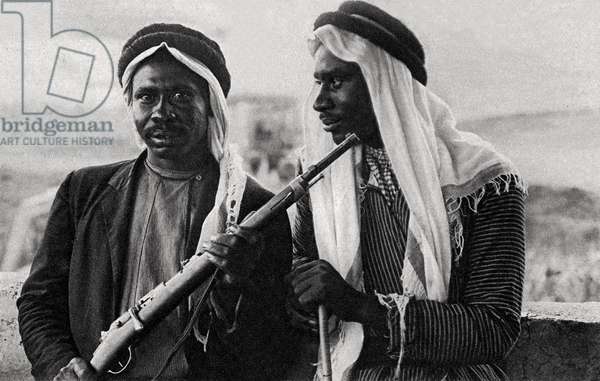
In the world of artificial intelligence, the question of representation is critical. AI systems like ChatGPT, which are trained on vast amounts of publicly available data, shape how we engage with knowledge, culture, and history. Yet, when it comes to Black Arabs and Black North Africans, these systems often fail to reflect the true diversity of the region. Why? Because the data they are trained on is fundamentally incomplete, and this gap perpetuates a harmful erasure of these communities’ identities and histories.
But how does this erasure happen? And what does it say about the AI’s role in reinforcing, rather than challenging, centuries of marginalization?
Step 1: Data Collection – The Foundation of Knowledge
How AI Models Are Trained:
The first step in training any AI model is gathering a massive amount of data. This data comes from a range of sources: books, websites, news articles, social media, and even scientific journals. AI doesn’t “know” what’s true or false—it learns patterns from what it’s fed. If that data is incomplete or biased, the AI’s output will be skewed.
The Problem with Black Arab Representation:
Here’s the issue: Black Arabs—and especially Black North Africans—are deeply underrepresented in the datasets used to train AI. This isn’t an accident; it’s the result of a centuries-old historical erasure. The narratives around North Africa have traditionally been framed as Arab or Mediterranean, with little attention paid to the Black Berber or Moorish influences that have shaped the region. In digital spaces, these voices are still absent or minimized. As a result, AI models are learning from historically narrow perspectives that don’t accurately reflect the true diversity of North African communities.
Step 2: Tokenization and Preprocessing – Reducing the Complexity of Language
The Technical Process:
Once the data is gathered, it goes through a process called tokenization, where the AI breaks down text into smaller units, like words or sub-words. From here, the AI begins to associate these tokens with broader meanings, learning how words and concepts are related.
Why This Matters for Black Arabs:
Tokenization isn’t just about words—it’s about understanding context. If the model isn’t trained on the unique ways in which Black Arabs speak, write, or express their identities, it risks reducing their culture and experience to a set of generic linguistic patterns that don’t capture their distinctiveness. If Black Arabs are missing from the data—or worse, misrepresented—the AI will fail to properly understand the richness of their linguistic diversity. In this way, Black Arab identity is flattened into a simple stereotype, rather than celebrated for its historical and cultural complexity.
Step 3: Training the Model – Learning from Patterns and Biases
The Core of AI Learning:
Training an AI model involves feeding it data over and over again, adjusting its internal parameters to predict the next word, sentence, or concept. The more it trains, the better it gets at identifying patterns in language. However, AI doesn’t know right from wrong—it simply learns patterns based on what it’s given.
The Consequences of Limited Representation:
When it comes to Black Arabs, the AI’s training process isn’t a neutral one. If the data is skewed toward Eurocentric or mainstream Arab perspectives, the AI will internalize these biases and reproduce them in its outputs. Imagine the question: “Are there Black Kabyles in Algeria?” If the model has been trained on a limited set of historical and cultural texts, it might only acknowledge Black Kabyles as a “possibility” or treat their existence as an exception, rather than a well-documented, integral part of the region’s history. This response doesn’t just reflect ignorance—it reflects a systematic erasure built into the very fabric of the training data.
Step 4: Fine-Tuning – The Effort to Fix Biases, but Not Enough
Why Fine-Tuning Is Essential:
Fine-tuning is the process of training a model on specific tasks, like answering questions or engaging in dialogue. It’s also an opportunity to address biases, where developers attempt to remove harmful patterns from the model’s responses. However, fine-tuning only works if the biases are already identified and addressed—something that is often not done sufficiently, especially when it comes to marginalized communities.
The Missing Piece for Black Arabs:
The problem here is that Black Arabs are still too often missing from the fine-tuning process. In many cases, AI developers might not be consciously aware of the cultural nuances that need to be represented. If fine-tuning datasets still reflect mainstream Arab perspectives without including Black Arab voices, then the model will continue to reinforce the stereotypes or simplified views that have been ingrained in its training.
Step 5: Deployment – AI in the Real World
AI in Action:
Once trained, the model is deployed and begins interacting with the world. It answers questions, provides recommendations, and generates text based on what it has learned. Here, the model’s biases, whether deliberate or unconscious, become very apparent.
The Impact on Black Arabs:
For Black Arabs and Black North Africans, this means that their identities can be misrepresented, ignored, or reduced to harmful stereotypes. When AI systems generate answers about their culture, history, or presence in North Africa, they often fail to acknowledge the rich, multi-faceted nature of Black Arab identity. Instead, they perpetuate the myth that Black Arabs are somehow foreign to the region, or that their Blackness is only a result of slavery or migration. The true diversity of Black Berber, Moorish, and Arab identities is obscured, leaving these communities invisible in the digital space.
Conclusion: The Urgency of Change
The absence of Black Arabs and Black North Africans in AI’s learning process is not a technical flaw—it is a cultural and ethical crisis. AI is meant to reflect the full spectrum of human knowledge, but when the history and experiences of marginalized groups are ignored or distorted, AI becomes part of the problem.
To fix this, we need more inclusive data, more diversity in training sets, and more collaboration with historians, cultural experts, and community representatives from Black Arab and North African populations. AI developers must take responsibility for ensuring that these groups are not just seen as an afterthought or a footnote in a larger, Eurocentric narrative.
AI should be a force for inclusivity, not erasure. Black Arabs are an integral part of North African history, culture, and identity. It’s time the digital world—through AI—recognizes them as such.
Until AI can represent all people accurately and inclusively, we will continue to see the erasure of Black Arab voices in both history and modern discourse, perpetuating the harm done by centuries of cultural marginalization.
Why Black Arabs are Affected:
- The lack of inclusive representation in the training data translates directly into how the AI responds when asked about Black Arabs or North Africans. If a user asks a question like, “Are there Black Kabyles in Algeria?” or “What are the cultural traditions of Black Tunisians?”, the AI might provide an answer that dilutes or misrepresents the rich diversity of these groups.
- The AI could fall back on generalized or Eurocentric narratives that ignore the reality of Black Arabs, framing them as a rare anomaly or explaining their presence as the result of slavery or migration, rather than acknowledging the long-standing and integral presence of Black communities in the region.
Conclusion: The Impact of This Process
The training of AI models, including those like ChatGPT, reflects and reinforces the biases present in the data they are trained on. For Black Arabs and Black North Africans, this means that their identities, histories, and cultures are often marginalized or misrepresented in AI systems.
To change this, AI developers must:
- Diversify data sources to ensure that Black Arabs and North Africans are well-represented, both in modern digital content and historical archives.
- Use bias mitigation strategies that specifically address the erasure of minority groups.
- Collaborate with cultural experts from marginalized communities to guide AI systems towards more accurate and inclusive representation of Black Arabs and North Africans.
Until these measures are implemented, AI systems will continue to reflect Eurocentric and over-simplified views of North Africa, further erasing the histories and experiences of Black Arab populations. It’s time to ensure that these communities are not only seen but heard and recognized in AI systems—just as they have always been an integral part of North African history and culture.
BlackArabsInAI


 Black Arabs In AI
Leave a comment